Football is back in America. With so many stories happening over the off season it is about time we get to see what each team looks like. Here is a brief look at tonight's preseason games.
Redskins At Bills 7:00 PM
Redskins: The introduction of Robert Griffin to the NFL. Will probably not play much but should be exciting to see how well he adjusts to the speed of the NFL.
Bills: Debut of DE Mario Williams. After a few years with the Texans "the guy picked before Reggie Bush" will get a chance to terrorize the AFC East. Vince Young also plays his first game with the Bills.
Ravens At Falcons
Ravens: Joe Flacco begins his contract year to prove that his worthy of an expensive extension. Ray Rice has already gotten his payday and will try to show that he deserves his contract.
Falcons: How has the team progressed? They didn't make any big moves other than signing Asante Samuel who is past his prime.
Saints At Patriots
Saints: In a battle of the NFL's favorite teams to punish the Saints play their second preseason under interim coach Joe Vitt. Vitt will leave the team after the preseason and then we will see how the team reacts to the bounty scandal. The Defense will also be watched closely.
Patriots: This team will always be a contender and this year is no difference. Brandon Lloyd plays his first game as a Patriot.
Steelers At Eagles
Steelers: First season playing without Hines Ward.
Eagles: Season two for the dream team. The defense needs to get it together and will the offense establish consistency.
Packers At Chargers:
Packers: after a disappointing end to the season last year the Packers will try to come back and win it all this year.
Chargers: a team that is always close but unable to finish, the Chargers are led by Phillip Rivers who is trying to prove that he is among the top 6 in NFL quarterbacks
Broncos At Bears
Broncos: PEYTON MANNING, 'nuff said
Bears: Need to find out who on the defensive side of the ball will fill in for Brian Urlacher.

Thursday, August 9, 2012

Top 20 Second Basemen

| Ranking | Player | Team |
| 1 | Robinson Cano | Yankees |
| 2 | Jamey Carroll | Twins |
| 3 | Darwin Barney | Cubs |
| 4 | Dustin Ackley | Mariners |
| 5 | Danny Espinosa | Nationals |
| 6 | Brandon Phillips | Reds |
| 7 | Omar Infante | Tigers |
| 8 | Aaron Hill | Diamondbacks |
| 9 | Neil Walker | Pirates |
| 10 | Dustin Pedroia | Red Sox |
| 11 | Howie Kendrick | Angels |
| 12 | Ian Kinsler | Rangers |
| 13 | Jason Kipnis | Indians |
| 14 | Steve Lombardozzi | Nationals |
| 15 | Dan Uggla | Braves |
| 16 | Gordon Beckham | White Sox |
| 17 | Ryan Theriot | Giants |
| 18 | Robert Andino | Orioles |
| 19 | Jemile Weeks | Athletics |
| 20 | Kelly Johnson | Blue Jays |
Players must play in 50 games at position or have played over half of their games at that
Wednesday, August 8, 2012
Top 10 Designated Hitters

| Ranking | Name | Team |
| 1 | Billy Butler | Royals |
| 2 | David Ortiz | Red Sox |
| 3 | Adam Dunn | White Sox |
| 4 | Michael Young | Rangers |
| 5 | Chris Davis | Orioles |
| 6 | Delmon Young | Tigers |
| 7 | Jesus Montero | Mariners |
| 8 | Kendrys Morales | Angels |
| 9 | Travis Hafner | Indians |
| 10 | Luke Scott | Rays |
Players must play at least half of their games at DH
Top 20 First Basemen

| Ranking | Name | Team |
| 1 | Mark Teixeira | Yankees |
| 2 | Albert Pujols | Angels |
| 3 | Adrian Gonzalez | Red Sox |
| 4 | Joey Votto | Reds |
| 5 | Adam LaRoche | Nationals |
| 6 | Paul Goldschmidt | Diamondbacks |
| 7 | Prince Fielder | Tigers |
| 8 | Carlos Pena | Rays |
| 9 | Yonder Alonso | Padres |
| 10 | Edwin Encarnacion | Blue Jays |
| 11 | Freddie Freeman | Braves |
| 12 | Casey McGehee | Yankees |
| 13 | Corey Hart | Brewers |
| 14 | Justin Smoak | Mariners |
| 15 | Paul Konerko | White Sox |
| 16 | Brandon Belt | Giants |
| 17 | James Loney | Dodgers |
| 18 | Carlos Lee | Marlins |
| 19 | Todd Helton | Rockies |
| 20 | Justin Morneau | Twins |
COmments: Casey McGahee doesn’t play anymore since he was traded for Chad Qualls
Players must have played 50 games plus majority of their games at first
Sunday, August 5, 2012
Ranking Instant Replay in Sports

| Hawk Eye Tennis Review |
Tennis has had a review system since the 2006 US Open where players were allowed so many challengers per set. The most common technology used in tennis the Hawk-eye system which uses slow-motion footage to decide whether or not the ball was in or out.
Pros: Around 30% of challenges are successful which is actually pretty high cause that means that officials are only 70% effective. Tennis is a good sport for instant replay because tennis players officiate themselves at a young age so they have a better idea of in or out calls and won't be as likely to waste challenges as they do in other sports.
Cons: None
Possible Improvements: I guess you could make Hawk-eye even more accurate.
2. Ice Hockey
Instant replay has been used by the NHL to determine whether or not a goal is actually goal since 1991. The league office has also been using it in recent years to punish players who participate in dirty play. The goal review is used to make sure the puck crosses the line and that the puck wasn't put into the net illegally. Goals toward end of period are also reviewed to make sure they crossed line before end of period
Cons: depends on the the home or national broadcast to feed footage(problem in Pittsburgh few years back where
Possible Improvements: league can set up own cameras
3. Basketball
Pros: covers most situations, refs get to decide when to use it
Cons: could add more situations to be reviewed
Possible Improvements: use it to punish players who flop, out of bounds calls
4. College Football
The Big Ten started using instant replay in 2004 and most conferences followed suit in 2005. By 2006, the NCAA made instant replay part of the rules. Although there is no unified code for instant replay, reviews can come from either a coach's challenge or from the video review official up in the press box. Most fouls cannot be challenged except for illegal forward pass and passing interference (only to wipe it off if ball was tipped before hand). Catches, down or not
Pros: replay can be initiated by official, usually very few challenges per game
Cons: coach's can challenge (which means there are either wasted challenges or teams get punished for challenging a call they sincerely thought was wrong), dead balls can't be reviewed (no way to fix that except to let play go on and fix later)
Possible Improvements: NCAA needs to have same replay rules for each conference
5. NFL
Pros: all scoring plays reviewed,
Cons: coach's challenges (see college football), dead balls can't be reviewed (see college football), booth challenges only allowed in last two minutes of half and overtime
Possible improvemnts: BOOTH REVIEWS ONLY
6. Baseball
Instant replay made its debut in baseball during the 2008 playoffs to determine whether or not a home run occurred. Fan interference, fair or foul, and whether or not a ball crossed the fence are eligible to be reviewed. The new Collective Bargaining Agreement which is currently being negotiated plans on expanding replay to all fair or foul calls, all fan interference, and whether or not the ball is caught. If those changes are put into play, baseball will shoot up the rankings but they haven't happened yet.
| umps running off to use replay |
Cons: not enough plays reviewed
Possible Improvements: add current proposed replayable plays as well as runner interference and fielder obstruction, as well as umpire's interference, possibly foot on bag or not, problem is that baseball depends on one call to effect how the rest of the play plays out
7. Soccer
Soccer still doesn't use any type of instant replay and so far the only technology I've seen them use walkie-talkies and temporary spray paint to mark where the wall can stand. FIFA's 2010 World Cup was covered by blown calls and they can fix this. The only problem is that FIFA is unwilling to change, in fact FIFA's president Sepp Blatter claims that blown calls add to the "fascination and popularity of football."(he can't be too bright, he helped Qatar get a world cup) The good news is that FIFA is looking into using the Hawk-eye technology that tennis uses to determine whether or not the ball crosses the goal line.
Sepp Blatter |
Cons: None cause it doesn't exist
Possible Improvements: review all goals to make sure players weren't offsides and that a handling of the ball didn't help the scorer, goals that are scored directly after an incorrect offsides call can be reversed, assistant ref can push button for assistance on who gets throw, corner kick, or goal kick, and of course technology to decide whether or not ball crossed line
Friday, August 3, 2012
Rule Number 5
Rule Number 5
 The recent trade that sent Shane Victorino to the Los Angeles Dodgers made me think about his career. The most significant effect he had on baseball didn't happen on the field, it made the Rule 5 draft relevant. Shane Victorino shouldn't be remembered for his clutch hits or his diving plays. He shouldn't be remembered for pointing at his head and then his midsection in game three of the 2008 NLCS. Shane Victorino is, and always should be, the face of the Rule 5 draft.
The Rule 5 Draft states that a player is eligible for the Rule 5 draft if they are not on the teams 40 man roster AND:
The recent trade that sent Shane Victorino to the Los Angeles Dodgers made me think about his career. The most significant effect he had on baseball didn't happen on the field, it made the Rule 5 draft relevant. Shane Victorino shouldn't be remembered for his clutch hits or his diving plays. He shouldn't be remembered for pointing at his head and then his midsection in game three of the 2008 NLCS. Shane Victorino is, and always should be, the face of the Rule 5 draft. The Rule 5 Draft states that a player is eligible for the Rule 5 draft if they are not on the teams 40 man roster AND:
– were signed at age 19 or older and have been in the organization for four years; OR:
– were signed at age 18 or younger and have been in the organization for five years.
 |
| Victorino with the Jacksonville Suns |
Victorino was drafted in the 1999 Rule 4 Draft (that's the technical term for the actual amateur draft) by the Los Angeles Dodgers out of high school at the age of 19. Therefore, he had to wait four years before he was eligible for the Rule 5 draft. Four years later, in the winter of 2002, Victorino was selected by the San Diego Padres via Rule 5. Once selected, the player must spend the entirety of the next season in the Major Leagues or they can be offered back to the team that they were taken from. The Padres used him sparingly, and with little success, in the first month of the season and they offered him back to the Dodgers on May 28th. He languished in the Dodgers minor league system, never getting higher than AA. In 2004 the Phillies decided to take him in the Rule 5 draft once again. Again he sputtered when given his shot in the bigs and he was promptly offered back to the Dodgers, who declined to take him back. .
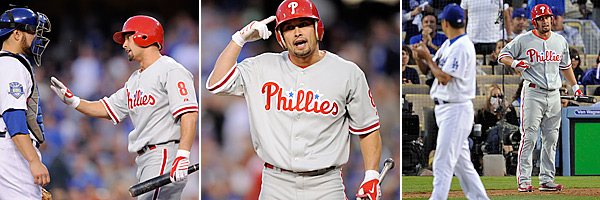 |
| Game 3 of the 2008 NLCS |
Finally Victorino started living up to the expectations. He hit .310 at AAA for the Phillies and was not only selected to the International League All-Star team, but he was selected as the MVP of the IL as well. He was named to the 2nd team all-minor league team by Baseball America and was awarded the Phillies minor league player of the year award. He got called up to the Phillies in September of 2004 and never looked back. He would take over right field for Bobby Abreu in 2006 and took over centerfield for Aaron Rowand in 2007. Shane Victorino is not the only success story, Jose Bautista, Johan Santana, Josh Hamilton, and Jayson Werth were also Rule 5 studs.
Rule 5 is a great way for players to get a chance that they never would have with another team. Victorino may never have gotten called up to play for the Dodgers and baseball would have been poorer for it. Certainly there is some risk with selecting a player in the Rule 5 draft, but with names like these coming from the draft there is also great reward.
Thursday, August 2, 2012
NL Central Deadline Madness

Every team in the National League's Central Division played a part in a major trade in the month of August. The Reds, who are leading the division by 3 games made the fewest but the pick of Jonathan Broxton improves there already steady bullpen. The Pirates and Cardinals also made themselves buyers at the deadline while the Astros, Brewers, and Cubs were all willing to give up one of their top pitchers for prospects. Here is a team by team look at all the NL Central moves.
Cincinnati Reds
 Already 3 games in front of the second place Pirates and 7 games ahead of the 3rd place team in the wild card race, the Reds did not need to make a huge change but they didn't hurt themselves by getting Jonathan Broxton. Broxton, who was the closer at Kansas City will move to a middle relief role for the Reds as Aroldis Chapman is their current closer. Broxton and Chapman have both been pretty good in the closer rule as they have gone 23 for 27 and 22 for 26 in save opportunities respectively. The Reds already had a great bullpen with 6 pitchers having ERAs at either 3 or below (team bullpen ERA of 2.61 is best in majors) and have completed 74% of their save opportunities (8th in majors). Donnie Joseph who became the Royal's #8 prospect after that trade has a chance to help the them right away as he is currently at AAA with a 2.86 ERA and a 1.409 WHIP. It is hard to imagine that those numbers represent a struggle at any level but at AA this year he had a .89 ERA with a .692 WHIP. J.C. Sulbaran was the other prospect in the trade and is 22 years old and at AA. He has an ERA of 4.04 and is a couple years away from the major leagues if he even ever gets there.
This subtle trade will help save the arms of the Reds rotations as they now have another trusted arm in the bullpen. The most important move that can happen for the Reds is for Joey Votto to come off the DL.
Chicago Cubs
The Cubbies find themselves 15.5 out of the wild card and 18.5 behind the the division leading Reds so it is safe to say that their season is over. They realized and quickly began to trade away for prospects. Catcher Geovany Soto and Pitcher Ryan Dempster (who everyone knew was going to be traded) were traded to the Rangers for Pitchers Jacob Brigham and Kyle Hendricks and 3B Christian Villanueva. To replace Soto, the Cubs called up Wellington Castillo up from the minors. Soto will serve as the Ranger's backup behind Matt Napoli while Dempster will become their #4 starter. Dempster's 2.25 ERA is well above average for an end of rotation starter. None of the prospects that the Rangers gave up are in their top 20 but both Dartmouth grad Hendricks and Mexican Villanueva show some upside.
 In a trade with the Braves that the Cubs clearly won, they were able to pick up 21 year old Arodys Vizcaino who was the #40 prospect in baseball at the beginning of the year. As a rookie this year he has a 4.67 ERA and is 1-1. He may be struggling in his first year but he is expected to become a reliable starting pitcher. Along with Vizcaino they received pitcher Jaye Chapman who has a 3.52 ERA in AAA this year. To receive those players they gave up Pitcher Paul Malhom and OF Reed Johnson. Both are decent major leaguers that should add depth to the Braves team but they were not needed on the Cubs.
Houston Astros
 Their last season in the National League and it is not a successful one as they have lost twice as many games as they have won. Perennial sellers at the deadline the Astros have given up Roy Oswalt and Hunter Pence in recent years, they were up to the same game this year and they picked up some solid prospects as they usually do but it is likely they won't take advantage of them. Earlier in the month they unloaded themselves of the weight that is Carlos Lee and in return by getting one of the Marlin's top prospects Matt Dominguez. They also got rid of veteran 3B Chris Johnson to the Diamondbacks in exchange for above average LF prospect Bobby Borchering. However their biggest trade was sending their ace Wandy Rodriguez to the Pirates for LHP Colton Cain, CF Robbie Grossman, and LHP Rudy Owens. Owens had a 3.14 ERA with the Pirates AAA team but since moving to the Astros his ERA has sky rocketed above 7. At age 24 he is getting old for a prospect but he is on the verge of becoming a major league pitcher. Like Owens, the 21 year old Cain has struggled since changing organizations. Grossman was hitting .266 in AA for the Pirates and in 6 games with the Astros is hitting .292. He is a speed threat with average power.
Milwaukee Brewers
The Brewers are 14.5 games outside first place so they did the smart thing by selling their biggest asset for prospects. In the off-season they lost their one of their best players, Prince Fielder, to free agency so many thought that they would not be able to contend this year. Ace Zack Greinke was sent to the Angels in return for some great prospects to replenish the farm system after they gave up so much to get Greinke. SS Jean Segura becomes their #1 overall prospect is hitting .297 this year at the AA level. The Brewers new #6 prospect is 23 year old Johnny Hellweg who is 5-10 at AA this year with a 3.38 ERA and a 1.38 WHIP. The third prospect they picked up in the trade is 23 year old Ariel Pena, after having a 2.99 ERA in AA with the Angels he struggled in his one start with the Brewer's AA team.
Pittsburgh Pirates
Currently 2.5 out of the division lead and holding onto a wild card spot the Pirates are in a position to make the playoffs but there is nothing wrong with bolstering their line up and rotation. The first big trade the Pirates made was getting SP Wandy Rodriguez from the Houston Astos(see Astros for prospects Pirates gave up). Wandy had a 3.79 ERA with a 1.270 WHIP in Houston but was mediocre in his first start in Pittsburgh giving up 3 runs in 6 innings. In a trade with the Marlins the Pirates were able to pick up one-time all star Gaby Sanchez and P Kyle Kaminska while giving up prospect OF Gorkys Hernandez. Kaminska and Hernandez are both 3rd level prospects but Sanchez could be a nice addition. After being an all star last year he has struggled this year only hitting .200 and will have to compete with Garrett Jones for playing time at first base as well as RF
 Travis Snider since Snider's acquisition moved Jones to 1B. Because of the Sanchez trade the Pirates were able to flip their old first baseman Casey McGehee to the Yankees for RP Chad Qualls. While losing McGehee hurts they found two replacements for him Qualls brings his 4.89 ERA to Pittsburgh. That might seem high but he has a respectable WHIP of 1.578. The Pirates weren't done though, as they traded for OF Travis Snider while giving the Blue Jays RHP Brad Lincoln. Lincoln was stellar in Pittsburgh this year with a 2.73 ERA mainly in relief appearances but the arrival of Wandy Rodriguez made him expendable. Snider has floated between the majors and the minors over the past couple of years but was off to a good start for the Blue Jays before being traded. He is only 24 and was hitting .325 in the minors this year.
St. Louis Cardinals
The Cardinals had probably the least exciting trade of the NL Central as they only made one and that was to pick up a mediocre relief pitcher in Edward Mujica while giving up way too much in the form of 3B Zack Cox who was rated as the #88 overall prospect in baseball by Baseball America. Mujica had a WHIP of 1.154 with Miami and has already thrown one perfect inning so far with the Cardinals. Cox was great at AA last year and mediocre at AAA this year but can be expected to help the Marlins in the future.
After reviewing all the trades Hawks Report believes that the division will end like this:
1. Pittsburgh Pirates; they did the most to improve their team and even if one trail fails they will have someone to pick up that slag
2. Cincinnati Reds (WC); The Pirates just themselves better than the Reds but they should be able to hold on for a wild card spot
3. St. Louis Cardinals; unless they can pull off the same magic as they did last year they won't be making the playoffs.
4. Milwaukee Brewers; building for the future
5. Chicago Cubs; same as Brewers
6. Houston Astros; moving to AL West next year where they will continue to dominate last place, building for never
Subscribe to:
Posts (Atom)