Showing posts with label playoffs. Show all posts

Wednesday, October 3, 2012

Using PER to rank the major league bullpens

despite the #1 bullpen, the rays were unable to
make the playoffs
It is commonly known that a good bullpen is a key to a strong season. Now that the season only has one day left I believe that now is a fair time to assess each team's bullpen for the 2012 season. According to PER , Hawks Report's new metric, PER, 7 out of the top 10 best bullpens in baseball have reached the playoffs. The number one bullpen in baseball , the Rays,are out of the Wild Card Showdown by 3.5 games before the last games end . The Diamondbacks also find themselves in the top 10 at spot number 6, they werable to finish 6 games out of the wild card despite also having one of the better offenses in the game. The three playoff teams that were outside the top 10 were the Cardinals (16), Tigers (19), and the Giants (25). Here are your 2012 team bullpen PER rankings. Teams in yellow have clinched the wild card,, blue have clinched the division, and orange have clinched a playoff spot.
Team IP TBF Rating
Rays 462.3 1877 0.246297
Braves 478.3 1968 0.243039
Athletics 505.6 2089 0.24203
Rangers 452.3 1870 0.241872
Diamondbacks 464.6 1930 0.240725
Orioles 542.3 2260 0.239956
Nationals 513 2149 0.238716
Reds 430.3 1804 0.238525
Yankees 442 1857 0.238018
Dodgers 461 1939 0.237751
Mariners 453 1906 0.237671
Red Sox 509 2142 0.237628
Indians 524 2207 0.237426
White Sox 463.6 1958 0.236772
Twins 555.6 2347 0.236728
Cardinals 470.3 1992 0.236094
Royals 559.3 2372 0.235793
Angels 442 1875 0.235733
Tigers 453.6 1926 0.235514
Padres 499 2121 0.235266
Pirates 495.3 2114 0.234295
Phillies 416.3 1782 0.233614
Blue Jays 526.6 2259 0.233112
Giants 449.6 1937 0.232112
Mets 457 1989 0.229764
Rockies 653 2864 0.228003
Marlins 454.3 1997 0.227491
Astros 499.3 2204 0.226543
Brewers 507.3 2252 0.225266
Cubs 488.3 2186 0.223376

Saturday, August 18, 2012

Planning the International Football League

image

After reading the book Soccer Against The Enemy I realized that soccer is no longer the game that is was 20 years ago. It use to be that the game was based off of domestic leagues in each country and each town would take great pride in their team no matter what division they were in. Often times, teams in the same town were divided along religious lines like in Glasgow where Celtic represents the republican catholics and the the Rangers are supported by the working class protestants or by nation-pride in Barcelona where Barcelona represents the Catalans and Espanol represents the non-catalans. Now a days, the game is so globalized that fans no longer route for their hometown team but for any team they know of growing up. Manchester United is one of the most popular brands in the world and they aren’t even the best team in their own city. To adjust to this there needs to be away for the best players in the world to compete against each other at all times. The World Cup allows this every 4 years and attempts by the Champion’s League, EuroLeague, Copa Libertadores, and the FIFA Club World Cup have attempted to do this on a yearly basis but their needs to be a change of strategy. These tournaments take the best teams from their respective region (in FIFA’s case the world) to compete in the tournament but that doesn’t produce the most desirable soccer on the planet.

Under the old system some of the world’s greatest players would not be able to compete in the elite tournaments because there team wasn’t good enough, the solution, make each team have some of the best players in the world. You need to be careful with this because you cannot destroy each country’s domestic league.Another benefit of a global elite league is that players will not be forced to leave their native country to play elite soccer so players will not be as effected by home sickness. 96 teams may seem like a lot for one league but in reality this will be 4 leagues that combine for a season ending playoff with a league representing each North America, South America + Caribbean, West Europe, and East Europe.

League Setup

North American Cities

  1. New York (2 teams)
  2. Philadelphia
  3. Los Angeles (2 teams)
  4. Denver
  5. Seattle
  6. Toronto
  7. Montreal
  8. Washington DC
  9. Portland, Oregon
  10. Boston
  11. Vancouver
  12. Dallas
  13. Mexico City (2 teams)
  14. Guadalajara
  15. Monterrey
  16. Tijuana
  17. Puebla
  18. San Francisco
  19. Houston
  20. Chicago
  21. Columbus

South American and Caribbean Cities

  1. Santo Domingo(Dominican Republic)
  2. San Juan(Puerto Rico)
  3. Havana(Cuba)
  4. Port-au-Prince(Haiti)
  5. Kingston(Jamaica)
  6. East-West Corridor, Trinidad and Tobago
  7. Greater Sao Paulo area, Brazil (2 teams)
  8. Bogota, Colombia
  9. Lima, Peru
  10. Greater Rio de Jaeiro area(2 teams), Brazil
  11. Porto Alegre, Brazil
  12. Montevideo, Uruguay
  13. Greater Buenos Aires area, Argentina(2 teams)
  14. Caracas, Venezuela
  15. Santiago, Chile
  16. San Cristobal, Venezuela
  17. Cordoba, Argentina
  18. Quito, Ecuador
  19. Belo Horizonte, Brazil
  20. La Plata, Argentina
  21. Asuncion, Paraguay

Western Europe

  1. London (2 teams)
  2. Manchester
  3. Madrid
  4. Barcelona
  5. Paris
  6. Milan
  7. Liverpool
  8. Amsterdam
  9. Berlin
  10. Munich
  11. The Hague
  12. Hamburg
  13. Athens
  14. Rome
  15. Naples
  16. Zurich
  17. Valencia
  18. Vienna
  19. Lisbon
  20. Dublin
  21. Glasgow
  22. Marseille
  23. Turin

Eastern Europe

  1. Bucharest
  2. Moscow (2 teams)
  3. Istanbul (2 teams)
  4. St. Petersburg(2 teams)
  5. Kiev
  6. Baku, Azerbaijan
  7. Minsk, Belarus
  8. Warsaw
  9. Budapest
  10. Belgrade
  11. Cairo
  12. Katowice
  13. Stockholm
  14. Prague(2 teams)
  15. Helinski
  16. Saratov
  17. Odessa
  18. Zagreb
  19. Alexandria
  20. Casablanca

Each team would play every member of their own league both home and away with 3 points for a win and 1 win for a draw. The top 4 teams from each table would qualify for the league playoffs which would be similar to the EuroCup. 4 pots would be created for drawing of groups for the tournament with each cup consisting of teams that finished the same place in their league so that all #1 seeds could advance to the finals. Each group would play a league with home and away matches similar to the regular season with only the number 1 team advancing to the semi-finals. The semi-finals would be a little Americanized with the team having the better regular season record getting home field advantage in a best of three game series. The final would be like the super bowl with the game being played at a pre-determined location.

In a later post we will establish the rules for players on each team as well as how each team will work with teams in their respective country’s domestic league.

Friday, August 3, 2012

Rule Number 5

Rule Number 5


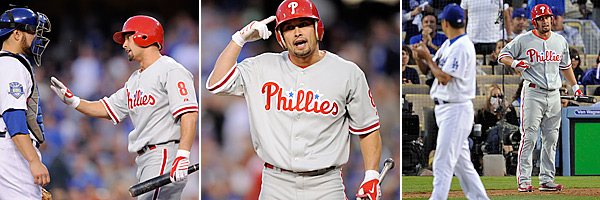
The recent trade that sent Shane Victorino to the Los Angeles Dodgers made me think about his career.  The most significant effect he had on baseball didn't happen on the field, it made the Rule 5 draft relevant.  Shane Victorino shouldn't be remembered for his clutch hits or his diving plays.  He shouldn't be remembered for pointing at his head and then his midsection in game three of the 2008 NLCS.  Shane Victorino is, and always should be, the face of the Rule 5 draft.

The Rule 5 Draft states that a player is eligible for the Rule 5 draft if they are not on the teams 40 man roster AND:


– were signed at age 19 or older and have been in the organization for four years; OR:
– were signed at age 18 or younger and have been in the organization for five years.

Victorino with the Jacksonville Suns
Victorino was drafted in the 1999 Rule 4 Draft (that's the technical term for the actual amateur draft) by the Los Angeles Dodgers out of high school at the age of 19.  Therefore, he had to wait four years before he was eligible for the Rule 5 draft.  Four years later, in the winter of 2002, Victorino was selected by the San Diego Padres via Rule 5.  Once selected, the player must spend the entirety of the next season in the Major Leagues or they can be offered back to the team that they were taken from.  The Padres used him sparingly, and with little success, in the first month of the season and they offered him back to the Dodgers on May 28th.  He languished in the Dodgers minor league system, never getting higher than AA.  In 2004 the Phillies decided to take him in the Rule 5 draft once again.  Again he sputtered when given his shot in the bigs and he was promptly offered back to the Dodgers, who declined       to take him back.                     .                        

Game 3 of the 2008 NLCS
Finally Victorino started living up to the expectations.  He hit .310 at AAA for the Phillies and was not only selected to the International League All-Star team, but he was selected as the MVP of the IL as well.  He was named to the 2nd team all-minor league team by Baseball America and was awarded the Phillies minor league player of the year award.  He got called up to the Phillies in September of 2004 and never looked back.  He would take over right field for Bobby Abreu in 2006 and took over centerfield for Aaron Rowand in 2007.  Shane Victorino is not the only success story, Jose Bautista, Johan Santana, Josh Hamilton, and Jayson Werth were also Rule 5 studs.  

Rule 5 is a great way for players to get a chance that they never would have with another team.  Victorino may never have gotten called up to play for the Dodgers and baseball would have been poorer for it.  Certainly there is some risk with selecting a player in the Rule 5 draft, but with names like these coming from the draft there is also great reward.  

Tuesday, June 26, 2012

College Football Playoff Proposal


 With the BCS about to go to a playoff, they need to find a format that will make everyone happy. With some conferences asking that conference champions hold an edge over non-champions while others want a selection committee to pick the top 8 teams. I am a proponent of the conference champions argument because of two reasons. I feel that the regular season should hold great value and that means that if you can't win your conference championship then you don't deserve to compete for a national championship. Also, it allows teams to schedule tougher non-conference games because they will not have as much of an effect on their national championship hopes which means that we will get to see better football. I prefer an 8 team playoff over a 4 team playoff because there are currently 6 BCS conferences and I feel that you should not leave one of them out. It also means more football games and schools cannot argue that players will miss classes because they will be on winter break. Under my system conferences will be divided into 3 tiers. Tier I will consist of the top 5 conferences according to the ESPN Stats & Info Conference Power Rankings. Tier II will consist of the middle 3 and Tier III will consist of the 3 worst conferences. Conferences Now that that is handled I will now present my playoff system. 

1. All playoff teams must be in the BCS top 25
    My system will continue the use of the current BCS system to decide who the best teams in the country are. This rule is to prevent teams that would qualify through the following routes but are below playoff standard from lessening the quality of playoff football. If less than 8 teams qualify for playoffs because of the top 25 requirement, at large bids will be offered to teams that won their conference but did not qualify for playoffs; if no such team exists the bid would be offered to the highest ranked BCS non-qualifier. If for some reason a Tier I conference champion is not in the top 25 their spot would be handed to the highest BCS ranked team from their conference.

2. Tier I conferences have automatic qualifiers for their champion
    Starting in 2013 the Tier 1 conferences will be the Big Ten, Big 12, Pacific-12, Southeastern Conference, and the Mountain West Conference. The ACC and Big East were demoted from the AQs because of recent poor performance and because of the exceptional play of the Mountain West. the MWC will likely drop to Tier II after a few years because their top teams are leaving the conference.

3. 2 teams will make the playoffs from Tier II conferencs
    Tier II will consist of the ACC, Big East, and Conference-USA as well as the independents. Keep in mind that the rules only guarantee 2 teams but there is a good chance that each conference will be represented because of the "Top 25" rule. Independents will qualify if they have a higher BCS ranking than 2 of the conference champions.

4. 1 team will have a semi-guaranteed playoff spot from Tier III conferences 
   Tier III teams will be Western Athletic Conference, Middle American Conference, and the Sun Belt. Since  these are lower level conferences it is not very likely that they will send a team to playoffs.

5. How will games be played?
    What is unique about my system is that the current bowl system will be kept in use. Even current bowl contracts will be respected. This could mean that #1 could meet #2 in the first round of playoffs but that shouldn't be a problem. The 4 current BCS bowls will be used for the quarter finals so the Big Ten's champion will always meet the Pac-12 champion in the Rose Bowl. The Semi Finals will be known as the BCS semifinals which will be followed by the BCS final. The quarter finals will take place over December 31st and January 1st. One game played on December 31st will be at 6pm (all times are Eastern) while January 1st would have games at noon, 3pm, and 6pm. Fitting in the semi-finals will be difficult because an attempt should be made to have the games on the weekend. Semi-finals must be a minimum of 5 days after the quarter-finals and will be held on a Friday and Saturday. The Friday game will be at 7pm and the Saturday game would be at 3 pm. There would not be a direct bracket to link teams from quarter-finals to semis but the 4 teams who survived the quarters would be paired by geographical closeness.  The championship game will be held on a Saturday at 6:30 PM. With this schedule the student-athletes will be able to return to their classes because their season would be done by the end of winter break. 
  
6. Where will games be played? 
    The quarter-finals will be held at BCS bowl sites because of that tie in. The Semi-Finals would be held in one stadium out of a pool of stadiums that are reserved for Semi Final play. This is to ensure that fans will be able to get to games. The reason for teams being paired by geographical closeness is so that the stadiums will be filled on game day. The Final will be held at a rotating site consisting of some of the most storied college football stadiums in America.

With this system I believe that everyone could be made happy. Fans can get to games, athletes will be back before winter break ends, conference champions will have playoff preference, and there will be a true National Champion.

Tuesday, October 18, 2011

Fixing College Football Mole's Way

 For the past year or so, teams in major college football have been rumored to switch conferences. Many people seem to believe that schools want to switch conferences to better the competition they face, I feel that this whole ordeal is about money, that's right, cold hard green cash. The Big Ten Conference was formed in 1895 as a way for the colleges to regulate football rules, a few years after that the NCAA was formed and governed college football throughout the country. After that, the point of the smaller regional conferences was to make it easier for schools to schedule games and officiating. Now I am going to remind you that was 100 years ago when teams preferred to play teams withing 200-300 miles so they wouldn't have to travel. All conferences back then were regional and did not mix teams in Louisiana with teams in California.

All those states have teams in the Western Athletic Conference

Not earning their potential revenue
  Right now, teams are moving conferences just so they can take advantage of financial opportunities that other  conferences supply. The only schools that get help because of conferences are the small schools that never compete for national championships and only make money because they are in the same conference as the most prestigious and elite programs. Boise State may be the school most hurt by the conference system. If they were an independent team that could schedule whoever they wanted and didn't have to play cupcakes week in and week out, they might of played in a national championship game. Not to mention that if they were able to negotiate their own TV deal, they would most likely receive more money than they would in their current deal with the Mountain West Conference. Vanderbilt is an example of a team that takes advantage of the system. They are members of the SEC and are lucky to get more than 3 wins a year, but yet they bring in the same amount of TV money as Florida. For a sport that obviously does not care about parity, they do a shitty job of allowing schools to take advantage of their own self-worth.

I feel as if there are three options for college football at this point, and there is no middle ground when it comes to how I feel about college football.
1. Mark Titus's theory on college conferences; go to Grantland.com for more info
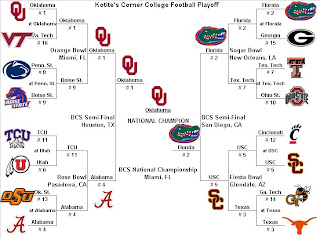
A possible 2008 bracket, wouldn't that just ruin college football
2. Have all schools join regional  conferences and adopt a playoff system. Right now there are 120 FBS teams so they could split everyone up into ten twelve team conferences. Each conference would then be split into two divisions, again based on location, each team would play all 5 teams in their division and half the teams in the other division, those games would switch on a year to year basis according to the teams end of year record and power ranking. This will undoubtedly make the regular season more exciting, as one loss could possibly mean the the team might not make their conference championship game. Sure, teams with one or two losses might make the playoffs, but it's better than no loss teams not having a chance to win a title. The winner of each division would then play for the conference championship game, with the winner receiving an automatic entry into a 16 team playoff. To decide the 6 teams that will join the conference winners, a BCS type system would be used. The at large teams would not half to be the runner ups but any team in the nation, meaning that a conference could end up sending 7 teams to the playoffs, although that would be very unlikely. In a addition to all conferences having equal playoff rights, all teams in the country would receive the same amount money.
         The last part of this plan is debatable, I feel this would be the best option but I part of me also      
         feels the stronger conferences should be able to make more money than the weaker ones.

3. This idea is pure capitalism, except that they are no trusts, sweat shops, or 2 year olds working 16 hours a day in a shed. NO conferences, that's right, each team for themselves when it comes to making bowl games and making cash. These idea does not need much explanation. Every team can schedule as many games as they want against whatever teams they want to, and at the end of the year each bowl's selection committee decides which teams it would like to invite to their game. Sure, you would almost never have an actual championship game, but college football worked so well without one for so many years. In this system the rich get richer and the poor get more poor. This is exactly why laissez faire economies never work. This system would eventually self implode as the bad schools would stop fielding a football team because they make no money and scholarship opportunities would be limited for student athletes and college football would become a 45 team league. This brings me to my next point, there are no rules on scholarships in this system either. If a school can give out 200 athletic scholarships, good for them, I'm sure they will enjoy the national championships.

There, I offered my solutions to college football, I want to see what other ideas you guys out there have and I honestly wouldn't be surprised if the NCAA someday follows #3, since it is clearly the worst choice in my mind.

Sunday, October 16, 2011

Cruz Cruisin


I've got some beef. Why in the world was Nelson Cruz allowed to hit six home runs in one play off series? It defies all logic and I simply cannot believe that the Tigers were so blind that they couldn't make an adjustment to get him out. Nelson Cruz is not that great of a hitter. He isn't Albert Pujols, Ryan Braun or Miguel Cabrera. He is not a hitter that makes good pitches look like meatballs and he doesn't do crazy things with a bat that mortals can't fathom.
Case in point, game 5 of the ALCS. Granted he was facing Justin Verlander arguably the best pitcher in baseball right now and without a doubt one of two pitchers with absolutely unhittable stuff. Following is the pitch sequence to Nelly Cruz. Pitch 1 - Fastball that is so right down the middle that I'm sure Nelson couldn't believe it was happening. Pitch 2 - Fastball up in the strike zone that Cruz apparently didn't agree with despite the fact that it was belt high over the middle. Pitch 3 - A hanging curveball that should've been hit 98375789235 feet. Cruz almost crapped his pants and made a swing that would make every little league uncoordinated benchwarmer everywhere proud. Three pitches, one out.
Nelson Cruz receiving ALCS MVP

Nelson is a professional hitter and he gets paid to mash the ball all over the park, but he is also facing professional pitchers and their staff of video watching, chart making, analysts. One would think that eventually someone in the Tigers organization would say hey, Nelson Cruz can't hit a pitch low and away and throw every pitch of every at bat there. Look at his slugging chart which is a tomato red over the middle of the plate, inside, high, low, but wait! What is this blue/black we see on the outside corner? Thats exactly where anyone with half a brain should pitch Nelson Cruz until he proves he can hit it.


The same problem occured last year with the Philadelphia Phillies in their NLCS matchup with the San Francisco Giants. They ran up against the Cody Ross brigade who apparently loves to hit pitches on the low inside corner and apparently the Phillies pitchers loved getting whiplash from watching Cody Ross destroy balls over the left field fence. I know blind men who could tell you where you absolutely couldn't throw a pitch to Cody Ross. However, the Phillies pitchers didn't get it and got hurt again, and again, and again.
My problem is not that Nelson Cruz broke the record for hitting the most homeruns in a playoff series. Congratulations to Cruz. My problem lies with pitchers who get paid to throw pitches, coaches who get paid to tell them where to pitch it, and analysts who tell the coaches where hitters can't hit. All I'm saying is that if any team out there needs someone with a little common sense, I'm available.