Every team in the National League's Central Division played a part in a major trade in the month of August. The Reds, who are leading the division by 3 games made the fewest but the pick of Jonathan Broxton improves there already steady bullpen. The Pirates and Cardinals also made themselves buyers at the deadline while the Astros, Brewers, and Cubs were all willing to give up one of their top pitchers for prospects. Here is a team by team look at all the NL Central moves.
Cincinnati Reds

Already 3 games in front of the second place Pirates and 7 games ahead of the 3rd place team in the wild card race, the Reds did not need to make a huge change but they didn't hurt themselves by getting Jonathan Broxton. Broxton, who was the closer at Kansas City will move to a middle relief role for the Reds as Aroldis Chapman is their current closer. Broxton and Chapman have both been pretty good in the closer rule as they have gone 23 for 27 and 22 for 26 in save opportunities respectively. The Reds already had a great bullpen with 6 pitchers having ERAs at either 3 or below (team bullpen ERA of 2.61 is best in majors) and have completed 74% of their save opportunities (8th in majors). Donnie Joseph who became the Royal's #8 prospect after that trade has a chance to help the them right away as he is currently at AAA with a 2.86 ERA and a 1.409 WHIP. It is hard to imagine that those numbers represent a struggle at any level but at AA this year he had a .89 ERA with a .692 WHIP. J.C. Sulbaran was the other prospect in the trade and is 22 years old and at AA. He has an ERA of 4.04 and is a couple years away from the major leagues if he even ever gets there.
This subtle trade will help save the arms of the Reds rotations as they now have another trusted arm in the bullpen. The most important move that can happen for the Reds is for Joey Votto to come off the DL.
Chicago Cubs
The Cubbies find themselves 15.5 out of the wild card and 18.5 behind the the division leading Reds so it is safe to say that their season is over. They realized and quickly began to trade away for prospects. Catcher Geovany Soto and Pitcher Ryan Dempster (who everyone knew was going to be traded) were traded to the Rangers for Pitchers Jacob Brigham and Kyle Hendricks and 3B Christian Villanueva. To replace Soto, the Cubs called up Wellington Castillo up from the minors. Soto will serve as the Ranger's backup behind Matt Napoli while Dempster will become their #4 starter. Dempster's 2.25 ERA is well above average for an end of rotation starter. None of the prospects that the Rangers gave up are in their top 20 but both Dartmouth grad Hendricks and Mexican Villanueva show some upside.

In a trade with the Braves that the Cubs clearly won, they were able to pick up 21 year old Arodys Vizcaino who was the #40 prospect in baseball at the beginning of the year. As a rookie this year he has a 4.67 ERA and is 1-1. He may be struggling in his first year but he is expected to become a reliable starting pitcher. Along with Vizcaino they received pitcher Jaye Chapman who has a 3.52 ERA in AAA this year. To receive those players they gave up Pitcher Paul Malhom and OF Reed Johnson. Both are decent major leaguers that should add depth to the Braves team but they were not needed on the Cubs.
Houston Astros

Their last season in the National League and it is not a successful one as they have lost twice as many games as they have won. Perennial sellers at the deadline the Astros have given up Roy Oswalt and Hunter Pence in recent years, they were up to the same game this year and they picked up some solid prospects as they usually do but it is likely they won't take advantage of them. Earlier in the month they unloaded themselves of the weight that is Carlos Lee and in return by getting one of the Marlin's top prospects Matt Dominguez. They also got rid of veteran 3B Chris Johnson to the Diamondbacks in exchange for above average LF prospect Bobby Borchering. However their biggest trade was sending their ace Wandy Rodriguez to the Pirates for LHP Colton Cain, CF Robbie Grossman, and LHP Rudy Owens. Owens had a 3.14 ERA with the Pirates AAA team but since moving to the Astros his ERA has sky rocketed above 7. At age 24 he is getting old for a prospect but he is on the verge of becoming a major league pitcher. Like Owens, the 21 year old Cain has struggled since changing organizations. Grossman was hitting .266 in AA for the Pirates and in 6 games with the Astros is hitting .292. He is a speed threat with average power.
Milwaukee Brewers
The Brewers are 14.5 games outside first place so they did the smart thing by selling their biggest asset for prospects. In the off-season they lost their one of their best players, Prince Fielder, to free agency so many thought that they would not be able to contend this year. Ace Zack Greinke was sent to the Angels in return for some great prospects to replenish the farm system after they gave up so much to get Greinke. SS Jean Segura becomes their #1 overall prospect is hitting .297 this year at the AA level. The Brewers new #6 prospect is 23 year old Johnny Hellweg who is 5-10 at AA this year with a 3.38 ERA and a 1.38 WHIP. The third prospect they picked up in the trade is 23 year old Ariel Pena, after having a 2.99 ERA in AA with the Angels he struggled in his one start with the Brewer's AA team.
Pittsburgh Pirates
Currently 2.5 out of the division lead and holding onto a wild card spot the Pirates are in a position to make the playoffs but there is nothing wrong with bolstering their line up and rotation. The first big trade the Pirates made was getting SP Wandy Rodriguez from the Houston Astos(see Astros for prospects Pirates gave up). Wandy had a 3.79 ERA with a 1.270 WHIP in Houston but was mediocre in his first start in Pittsburgh giving up 3 runs in 6 innings. In a trade with the Marlins the Pirates were able to pick up one-time all star Gaby Sanchez and P Kyle Kaminska while giving up prospect OF Gorkys Hernandez. Kaminska and Hernandez are both 3rd level prospects but Sanchez could be a nice addition. After being an all star last year he has struggled this year only hitting .200 and will have to compete with Garrett Jones for playing time at first base as well as RF

Travis Snider since Snider's acquisition moved Jones to 1B. Because of the Sanchez trade the Pirates were able to flip their old first baseman Casey McGehee to the Yankees for RP Chad Qualls. While losing McGehee hurts they found two replacements for him Qualls brings his 4.89 ERA to Pittsburgh. That might seem high but he has a respectable WHIP of 1.578. The Pirates weren't done though, as they traded for OF Travis Snider while giving the Blue Jays RHP Brad Lincoln. Lincoln was stellar in Pittsburgh this year with a 2.73 ERA mainly in relief appearances but the arrival of Wandy Rodriguez made him expendable. Snider has floated between the majors and the minors over the past couple of years but was off to a good start for the Blue Jays before being traded. He is only 24 and was hitting .325 in the minors this year.
St. Louis Cardinals
The Cardinals had probably the least exciting trade of the NL Central as they only made one and that was to pick up a mediocre relief pitcher in Edward Mujica while giving up way too much in the form of 3B Zack Cox who was rated as the #88 overall prospect in baseball by Baseball America. Mujica had a WHIP of 1.154 with Miami and has already thrown one perfect inning so far with the Cardinals. Cox was great at AA last year and mediocre at AAA this year but can be expected to help the Marlins in the future.
After reviewing all the trades Hawks Report believes that the division will end like this:
1. Pittsburgh Pirates; they did the most to improve their team and even if one trail fails they will have someone to pick up that slag
2. Cincinnati Reds (WC); The Pirates just themselves better than the Reds but they should be able to hold on for a wild card spot
3. St. Louis Cardinals; unless they can pull off the same magic as they did last year they won't be making the playoffs.
4. Milwaukee Brewers; building for the future
5. Chicago Cubs; same as Brewers
6. Houston Astros; moving to AL West next year where they will continue to dominate last place, building for never

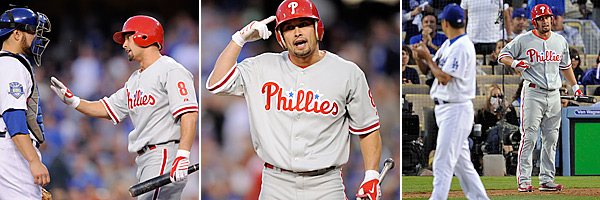
 The recent trade that sent Shane Victorino to the Los Angeles Dodgers made me think about his career. The most significant effect he had on baseball didn't happen on the field, it made the Rule 5 draft relevant. Shane Victorino shouldn't be remembered for his clutch hits or his diving plays. He shouldn't be remembered for pointing at his head and then his midsection in game three of the 2008 NLCS. Shane Victorino is, and always should be, the face of the Rule 5 draft.